Design Exercise
How do we turn a price-checking habit into a full-trip booking behavior?
// A self-directed design exercise in response to a brief from Hopper //
- Product Strategy
- Mobile UX
Overview
Reframing a price-watching loop into a planning surface, without breaking what users trust.
This was a self-directed design exercise in response to a brief: a travel app has built a deep moat in price prediction, but users return to check flight prices and then leave.
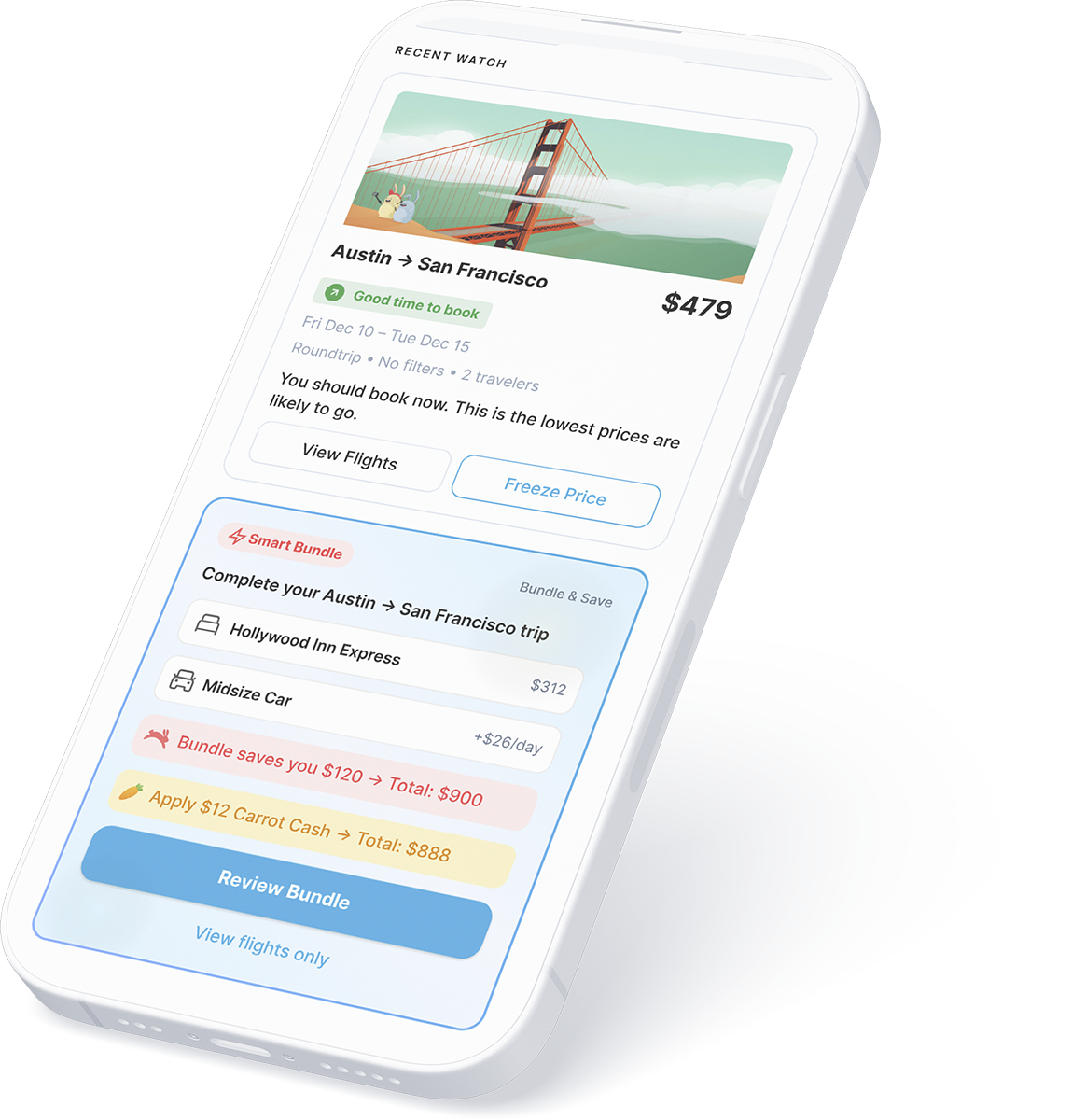
The work explores how to turn the highest-intent moment in the app, the watch re-entry, into a contextual gateway for the rest of the trip.
My Role
Solo Design Exercise | April 2026
I led the entire arc, from framing the problem, to modelling the LTV gap, defining the experience strategy, and prototyping the bridge module and protection redesign.
Deliverables included a 20-slide narrative, four annotated key screens, a four-state system-logic model, and a phased testing plan.
The Challenge
The app has built trust. It hasn’t built a trip.
Users return to check flight prices, then leave. The hotels, cars, and protection products that could 20× their lifetime value are invisible at re-entry.
$2

$96
LTV grows ~48× when a flight is bundled with a hotel and car. Today it almost never is.
38%
of customers book a flight and never attach a second product to the trip.
54%
of returning users re-enter the app specifically to check a flight watch.
Who we are designing for
The Deal Tracker
“I don’t want to book yet… I want to be sure this is the best price.”
Behaviour
- Returns frequently to check the price
- Heavily uses the Watch feature
- Engages with forecast predictions
- Delays booking until confidence peaks
- Motivated by getting the best deal
Pain points
- Fear of prices still dropping
- Uncertainty about when to commit
- Add-ons feel confusing & late-stage
- Trust breaks down at checkout
- Surprise fees erode confidence
Key Insight
The app builds confidence during discovery, but loses it at the moment of booking.
The monitoring loop has no natural exit ramp toward a full trip. No mechanism handles the hesitation moment.
The Highest-Intensity Moment
54% of returning users are checking a flight watch right now.
They arrive primed and emotionally invested. This is the highest-intent moment in the app
— and right now, it ends with no next step.
01
Push notification
Price alert fires
02
Home . Watch card
User checks price
03
Flight detail
Reads forecast
04
Close app
No next step offered
40% of users who check a watch engage with the forecast — they are actively processing a purchase decision.
Competitive Landscape
Competitors are closing the gap on bundling.
Our moat is prediction — not yet the trip.
| Platform | Core Strength | Price Intel | Bundling | Fintech | Gap |
|---|---|---|---|---|---|
| Hopper (today) Price prediction + fintech | Forecast + freeze + CFAR | ●●●●○ | ●●○○○ | ●●●●● | Not yet a full trip platform |
| Expedia Romie AI | Full-service OTA | ●●●○○ | ●●●●● | ●●○○○ | Pricing insight depth |
| Booking.com Destination-scoped | Destination bundles | ●●○○○ | ●●●●○ | ●●●○○ | No price prediction |
| Google Flights Speed + data | Aggregation + reach | ●●●●○ | ●○○○○ | ●○○○○ | No ecosystem / booking |
| Kayak Aggregator | Cross-OTA search | ●●●●○ | ●○○○○ | ●○○○○ | Doesn’t own booking |
Expedia’s Romie (2024) already does destination-scoped, date-aware multi-product cross-sell as a first-class AI feature. Our window to differentiate is narrowing.
Experience Strategy
Shift the app from a price tracker to a trip planner with smart bundles.
01
Current State
Monitoring
Users track prices and read forecasts. Introduce confidence signals – “Good time to book” – to reduce hesitation without disrupting core intent.
02
New – The Bridge
Planning
When the system detects high forecast confidence, introduce a contextual “Plan this trip” prompt. Surface a bundled hotel + car scoped to the watch destination and dates.
03
Optimized Checkout
Booking
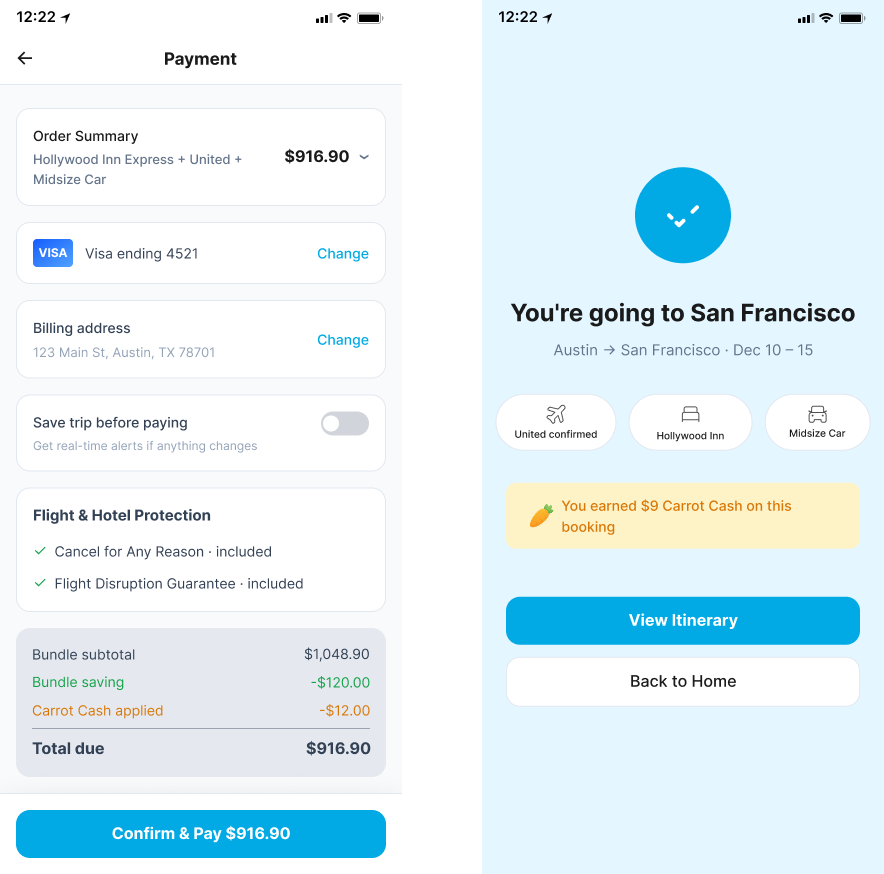
Replace fragmented add-on upsell with a single pre-configured bundle decision. One price. One CTA. Fewer choices, more commitment.
Design Hypothesis
The Intervention
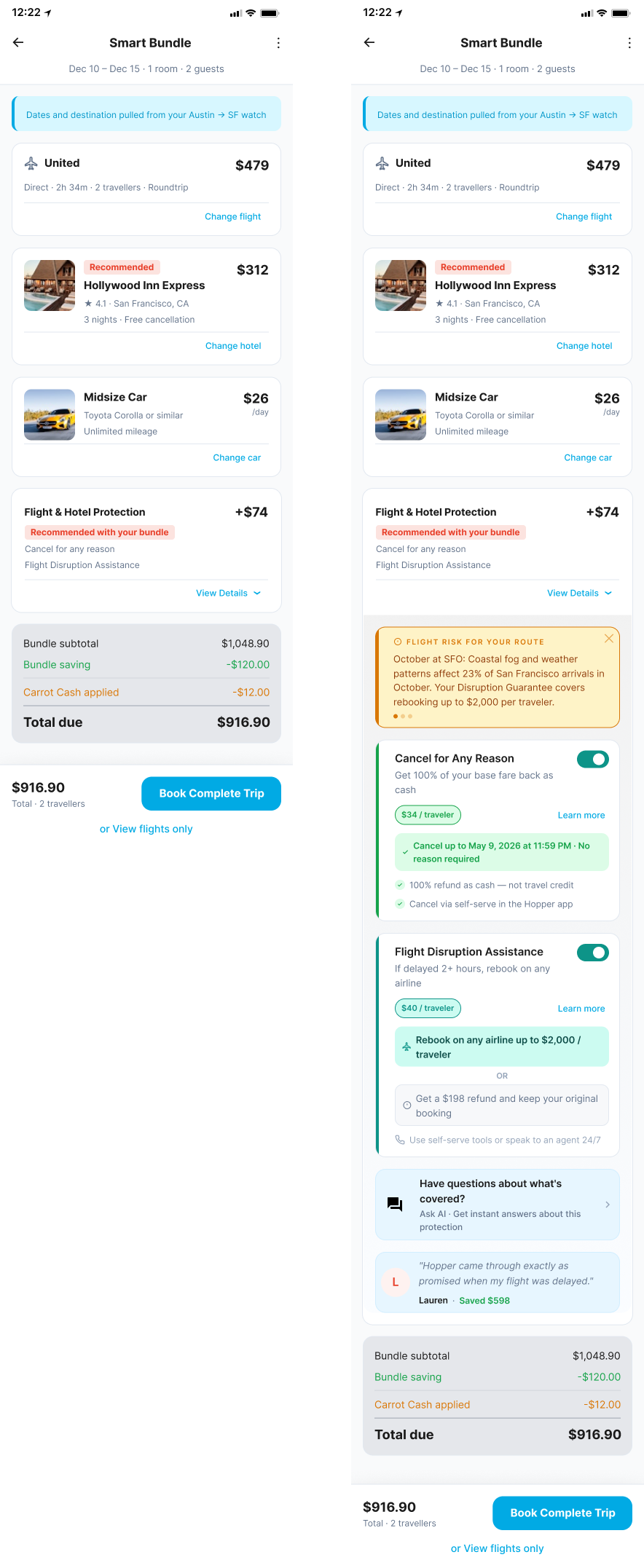
A contextual Home-screen module that activates on flight-watch re-entry, intelligently surfaces a hotel and car bundle scoped to the same destination and dates, and guides the user through a single cohesive trip decision — including contextual protection recommendations and an AI assist layer that handles objections at the moment of hesitation.
01
Data-led, not promotional
Every suggestion lives in the price-confidence language users already trust— no lifestyle copy.
02
Subordinate to the watch
The module never visually competes with the user’s primary reason for opening the app.
03
Pre-filled, not a blank search
Destination, dates, and travelers pre-loaded from the watch — zero extra input.
04
State-aware bundle logic
Module shows different content depending on: wait, book now, or prices rising.
04
Objection-handling built in
An AI assist layer answers hesitation in-context, without a separate screen.
System Logic
Four forecast states. Four module behaviors.
Book now
High confidence – buy now
Module: Full Smart Bundle card
“Now is the time. Lock in your hotel and car while prices are low.”
Review bundle
Wait
Price may still drop
Module: Lighter planning prompt
“Your flight is still tracking down. While you wait, see what hotels look like.”
Explore hotels
Monitoring
No clear signal yet
Module: Passive awareness strip
“Hotels in Miami, Nov 12–16 – no urgency, single tap to pre-filled search.
See hotels
Prices rising
Urgent – act now
Module: Full bundle + urgency signal
“Prices are rising. Book now and bundle your hotel to save an extra $47.”
Book a complete trip
Key Screen – Home / Watch Re-entry
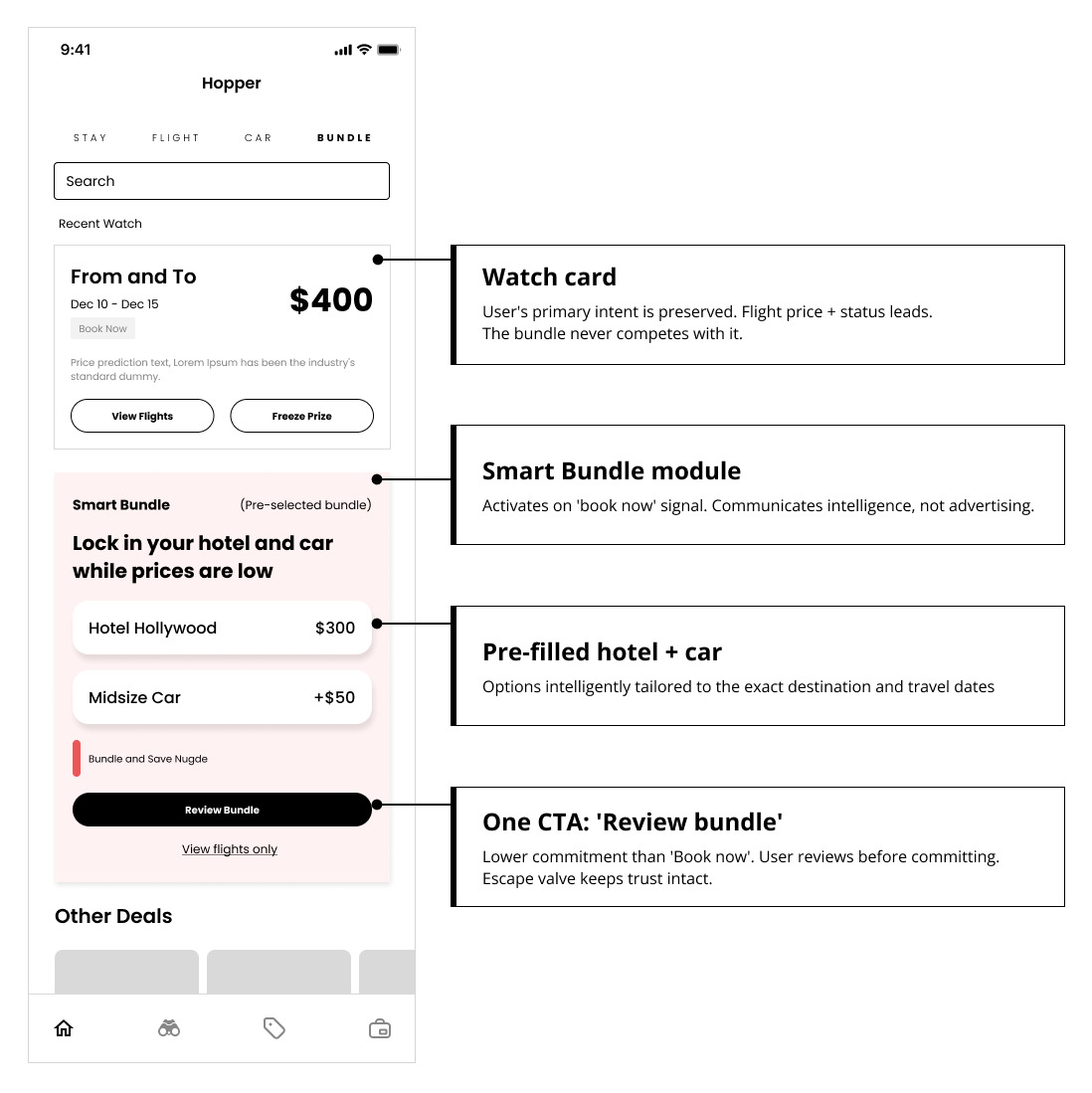
The ‘book now’ state
When the user returns and the forecast says it’s time to commit, the bundle activates beneath the watch — never above it.
The Protection Gap
The current protection experience
fails at the right moment.
Protection products account for ~40% of revenue, yet they’re invisible to users in the watch/wait phase — and at checkout, they appear as two unlabeled toggles.
Why does it fail today
- Protection is surfaced at checkout only — users in watch/wait never encounter it.
- Two unlabeled toggles provide no context for what either product covers.
- No mechanism handles the “what if nothing happens?” objection.
- Highest-margin items are treated as optional extras, not core value.
What the redesign does
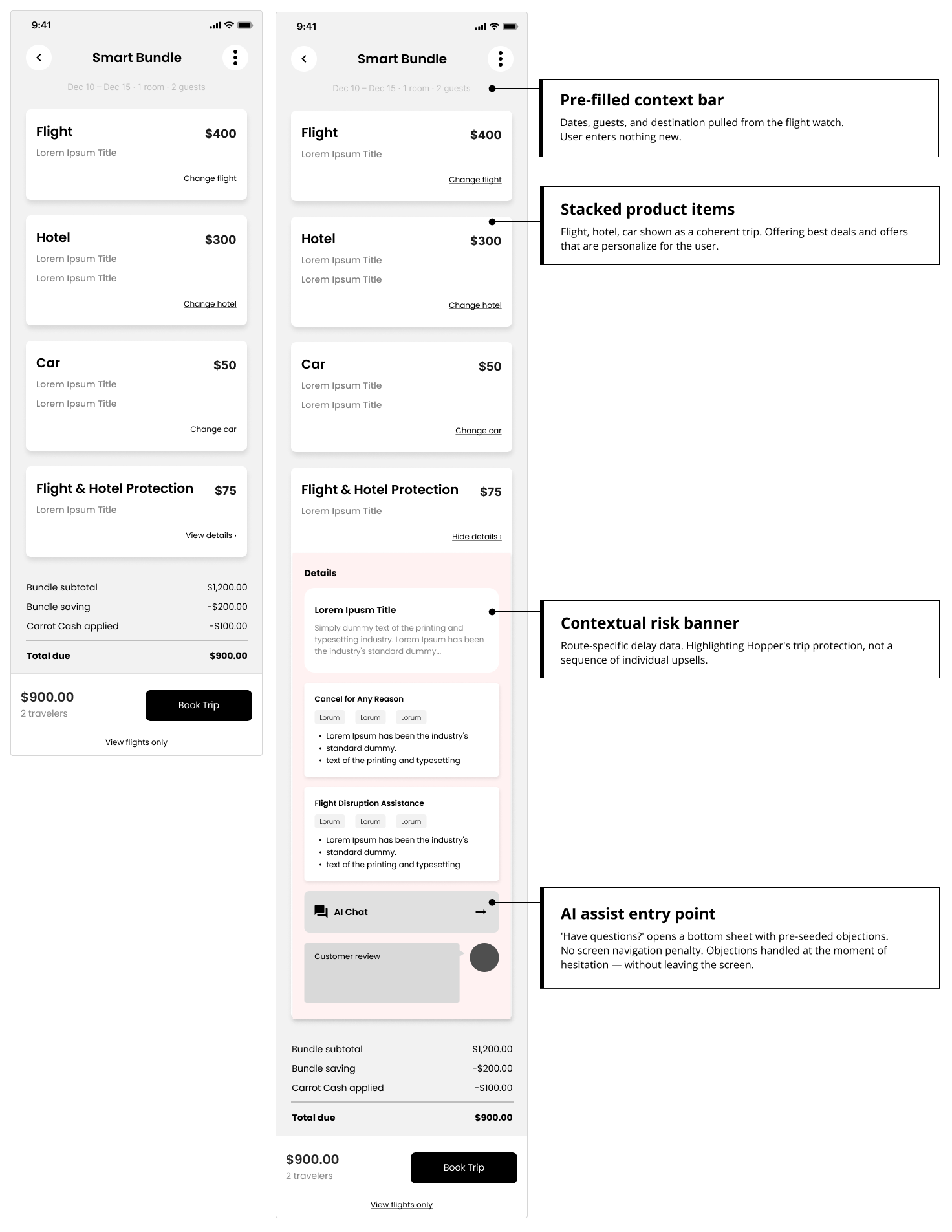
- Uses route prediction data to create a personalized risk reason — not generic insurance copy.
- Shows specific coverage amounts, deadlines, and refund mechanics directly in the bundle flow.
- Surfaces the CFAR cancellation deadline — making value concrete and time-bounded.
- Provides an AI objection-handling layer at the exact moment of hesitation.
The AI Assist Pattern
Objections handled at the moment of hesitation
— without leaving the screen.
Design assumptions & constraints
What I’m designing within
Key assumptions
- The watch object stores destination, outbound date, return date, and traveler count — accessible to the Home screen layer.
- Hotel and car search can be pre-filled from watch data without a visible API delay on load.
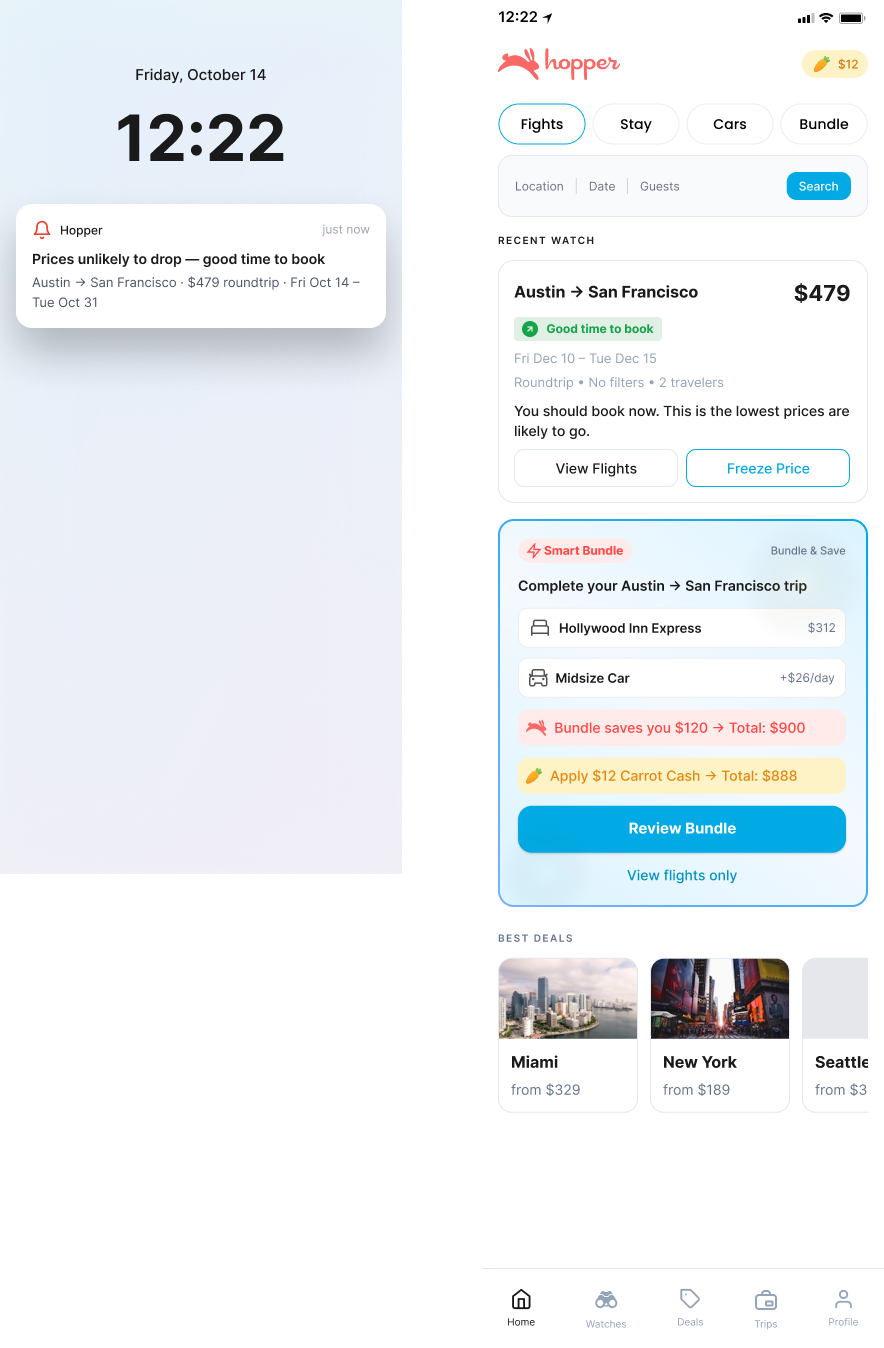
- The push notification deep-links to the Home/watch view, not directly to the flight detail.
- A modular Home-screen architecture can conditionally render a contextual block per user state.
- The route-specific risk signal is available in the existing prediction data store, with no new API required.
- The AI assist sheet uses pre-seeded Q&A pairs for the prototype; in production, it connects to a trained AI layer.
Hard constraints
- Must not visually compete with the flight watch card.
- Must use the company’s data-confidence language — never promotional or lifestyle copy.
- Must require zero additional user input to activate — no destination re-entry.
- Must work in short sessions (29% bounce rate) — cannot depend on scroll depth.
- Must be dismissible without penalizing the user or permanently suppressing the module.
- Protection AI bottom sheet must open as an overlay — no navigation penalty for asking a question.
Testing Plan
Four tests, in order
T1
Confidence nudge messaging
Adding confidence copy to the watch card will increase flight booking conversion.
Metric: Flight booking conversion from watch re-entry
Win: ≥ 3% absolute lift
Window: 4 weeks
T2
Smart Bundle module engagement
A pre-filled hotel + car bundle on home re-entry will achieve a higher hotel attach rate than the current separate-tab model.
Metric: Hotel search initiation in-session
with watch re-entry
Win: ≥ 5% absolute lift
Window: 4 weeks after T1
T3
Protection section redesign impact
Replacing unlabeled toggles with the contextual risk banner, mini product cards, and AI assist will increase protection attach rate.
Metric: % completing booking with ≥1 protection activetry
Win: ≥ 8% absolute lift
Window: 6 weeks
T4
End-to-end multi-product conversion
Combining winning nudge + bundle + protection redesign into a full flow will increase the multi-product booking rate.
Metric: Flight + ≥1 ancillary booking within
7 days of watch re-entry
Win: RPU lift at 30 days,
no increase in time-to-flight-booking
Window: 6 weeks
Success Metrics
How do we know it’s working
Revenue
- Revenue per user (RPU)
- Attach rate
- Bundle acceptance rate
Conversion
- Watch-to-booking conversion
- Drop-off after bundle exposure
- Time to booking
Engagement
- Engagement with nudges
- Protection AI engagement
Trust
- User satisfaction (CSAT)
- Bundle dismissal rate
Open Questions
What this design doesn’t yet answer
01
Bundle fatigue threshold
How much bundling is helpful before it overwhelms? We need to test bundle composition (2-product vs. 3-product) and establish a dismissal-rate ceiling.
02
The wait-state UX
When the system says “wait”, surfacing a full bundle creates a contradiction. The lighter “start planning” prompt needs its own design pass and A/B test.
03
Fintech products in the bundle
Price Freeze, CFAR, and Disruption are the highest-margin products. How do they sit inside the bundle — as defaults, opt-ins, or a separate decision?
04
Post-booking lifecycle
Once the flight is booked, how does the Smart Bundle become a “complete your trip” prompt in the Trips view? This is the natural next surface after home.
The opportunity isn’t just to sell more products.
It’s to change behavior.
By helping users move from “I’m still watching” to “I’m ready to book with confidence”, a price-prediction app can grow revenue while staying true to what users already value — feeling smart about their decisions.
If you want to talk through the decisions behind any of it, or what I’d do differently, I’d love that conversation.
Thank you for your time!
Other Projects

- B2B
- Systems Thinking
Modernizing Dell’s Commercial Quote Experience

- Vision
- Strategy
Shaping an AI Experience Vision Through System-Level Exploration

- Vision
- Strategy