Case Study
The Dell Design System Governance Engine
- Vision
- Strategy
Overview
Enterprise design systems rely on contributor workflows to scale, but governance often becomes a bottleneck.
The Dell Design System (DDS) Contributor Sandbox is the intake point for new design contributions, yet ensuring those contributions meet system standards still depends heavily on manual review.
Manual governance slows contribution velocity without guaranteeing consistency. This work explores how governance could shift from manual review to system‑supported guidance, protecting design quality at scale without sacrificing designer autonomy.

My Role
Lead Product Designer |2025 — 2026
I led the discovery and conceptual design for this governance model, focusing on:
- Research synthesis and problem framing
- Evaluation of existing governance tooling and plugins
- Definition of a unified governance concept and future vision
This work was strategic and exploratory, intended to inform future tooling and system direction rather than ship immediately.
The Challenge
The Dell Design System is being outpaced by demand, so teams design around it, creating fractured experiences, duplicated effort, and governance overhead that cannot scale.
This behavior fragments our experiences, duplicates effort, and erodes trust in the system as a single source of truth. Heavy, manual governance has become the default safeguard, but it cannot scale with the volume and speed of design decisions.
Current Workflow

In practice, the Dell Design System team spends much of its time on repetitive, manual governance tasks.

Reviewing each contribution for compliance manually

Delivering similar guidance across teams and files

Acting as gatekeepers instead of enablers
Research Scope
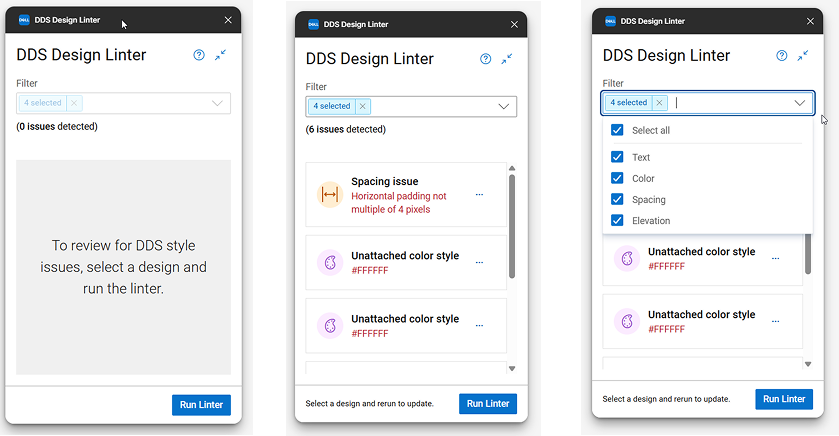
Plugin Landscape Evaluation
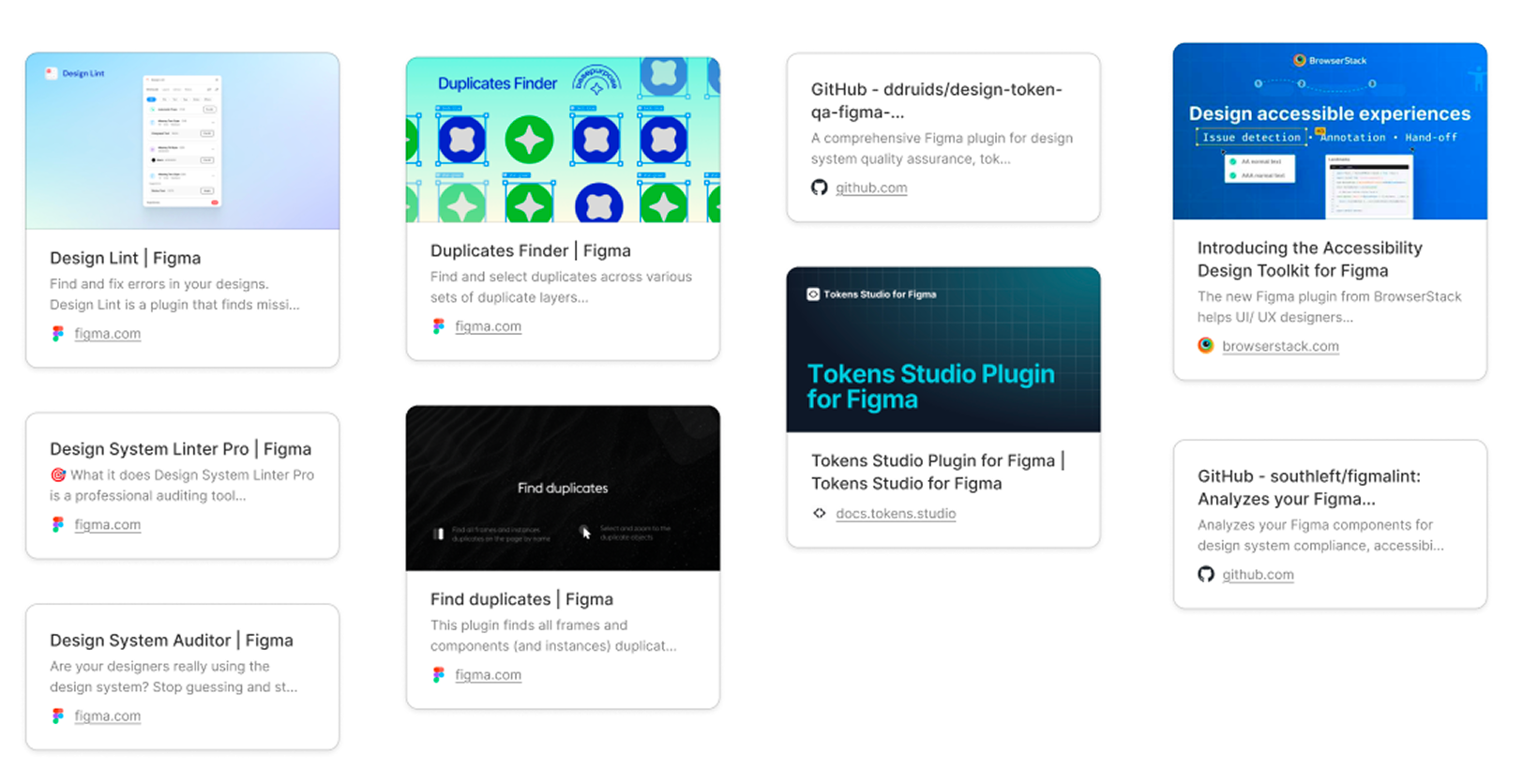
I evaluated existing Figma plugins across key governance areas, including linting, accessibility auditing, duplicate detection, and token and style management.
This evaluation revealed that the current DDS plugin performs only limited checks, exposing gaps in scalable governance coverage.
Each tool addresses a narrow problem,
but none support governance end-to-end.
Research Findings
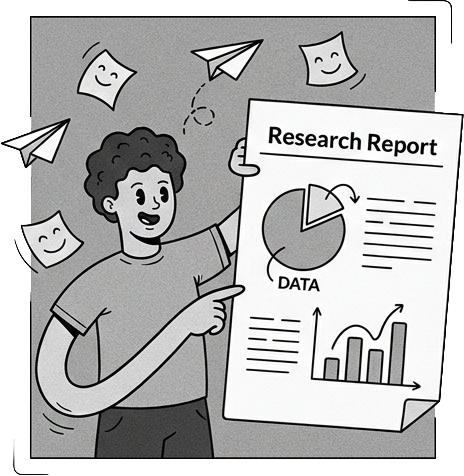
Structural Gaps in Governance
Individual tools effectively solve isolated governance problems, but they operate in disconnected workflows that require manual interpretation and reconciliation.
As a result, governance remains fragmented and reactive, confirming a structural gap rather than a simple tooling gap.
No single solution provides continuous, end-to-end DDS governance across design creation, validation, and standardization.
Key Insights
Design system governance breaks down not because of missing features, but because fragmented tools recreate manual review loops, slow feedback, and turn DDS teams into bottlenecks rather than enablers.
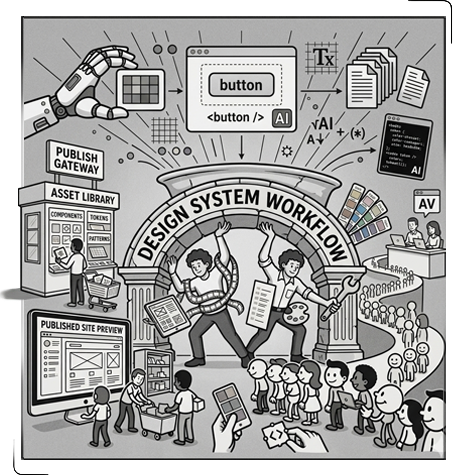
The opportunity is to shift governance from human review to system-supported guidance.
Opportunity for Innovation
Unified Design System Governance Engine
Evolve the existing DDS plugin into a single, intelligent governance layer inside Figma that continuously analyzes designs as they are created.
This enhanced plugin would detect DDS non-compliance across spacing, color, typography, and component structure, recognize similar components, and surface reuse opportunities with clear recommendations or safe auto-fix options – always with explicit designer consent.
From Manual Review to Real-Time Guidance
This concept reframes governance as an in-flow design experience rather than a late-stage checkpoint.
By replacing manual DDS audits, plugin-hopping workflows, and late-stage compliance reviews, the system provides real-time guidance that scales across enterprise files.
This reduces contributor back-and-forth, preserves designer autonomy, and enables DDS teams to move from gatekeeping to enablement.
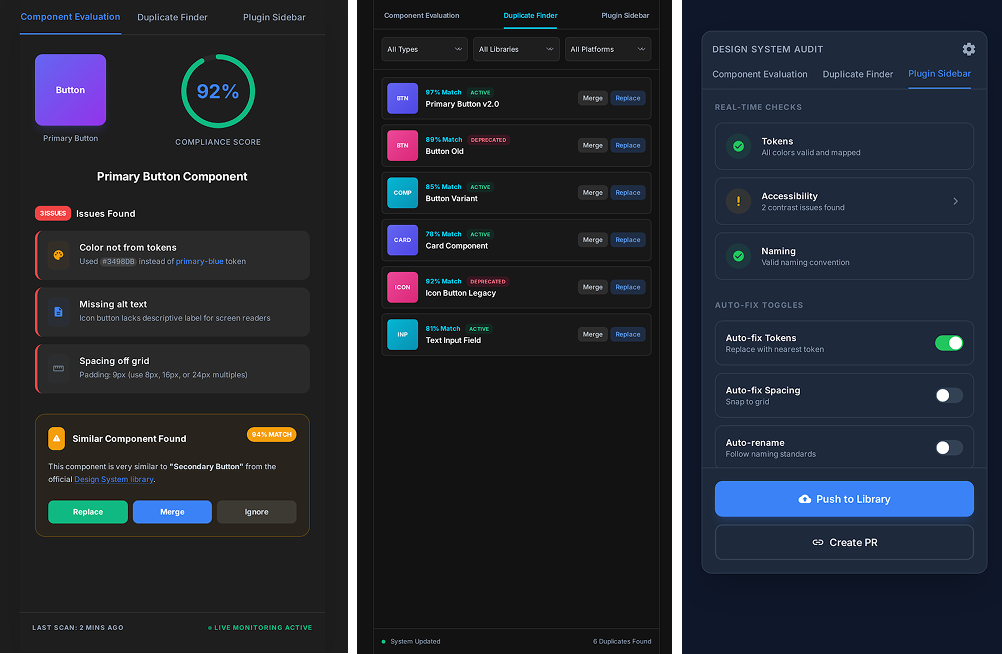
Core Features
These features work together as a single governance system rather than isolated checks.

Comprehensive
DDS Compliance Checks
Automatically validates spacing, color, typography, component structure, and pattern intent against DDS standards.

Component Intelligence and Reuse Detection
Identifies visually similar components and repeated UI patterns, recommending reuse or relinking to canonical DDS components with designer approval.

AI-Powered Fix Recommendations
Uses AI to suggest semantic tokens, layout corrections, component relinking, and accessibility improvements, each with a visible confidence score.

Safe Auto-Fix With Guardrails
Supports one-click or batch fixes through non-destructive changes that always require explicit user consent.

Token and Style Governance
Dynamically manages DDS variables and styles, flags unused or outdated tokens, and prevents accidental system-level deletions.

Accessibility by Default
Continuously checks contrast, touch targets, legibility, focus order, and inclusive design considerations as part of standard governance.
AI-Integrated Future Vision
From Governance Tooling to Design System Intelligence
Automation can enforce rules, but at scale, understanding intent is required.
Static checks can identify violations, yet they struggle with context, edge cases, and the natural evolution of design systems.
As patterns change and teams move faster, governance needs to become adaptive rather than reactive.
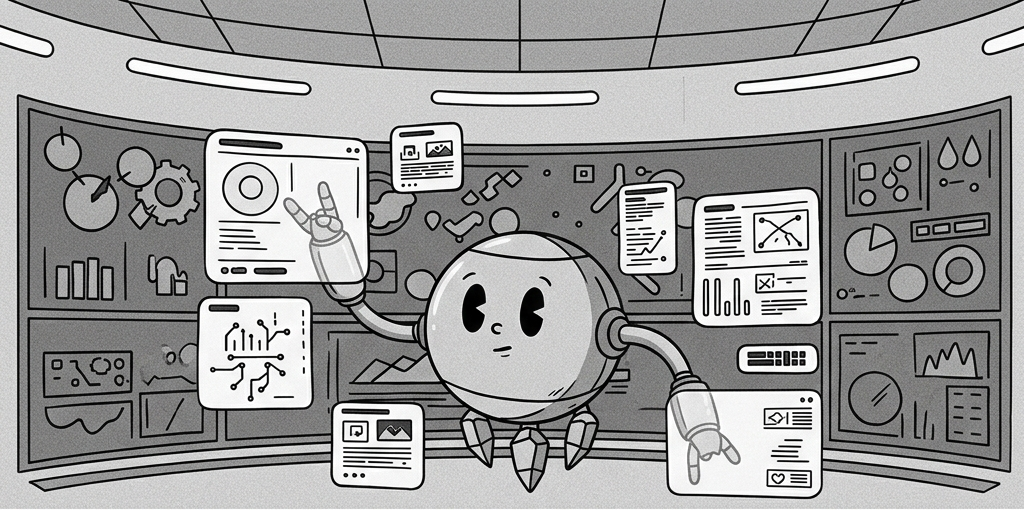
Opportunity for deeper AI integration.
Plug-in to DDS Agent
The next evolution is a DDS AI agent embedded directly into the design workflow.
Rather than operating as a passive checker, the agent acts as a collaborator that understands what designers are trying to build, learns from real decisions, and adapts its guidance over time.
Governance shifts from enforcement to partnership.

Intent-Aware Design Assistance
Anticipates design intent and suggests the right DDS components and tokens during creation.

Learning From Human Decisions
Adapts over time by learning from accepted, rejected, and approved design choices.

Living DDS Knowledge
Acts as an interactive interface to design system guidance, examples, and best practices.

Shared Design-Code Intelligence
Aligns design intent with production UI to catch divergence early.

Built-In Trust Guardrails
Keeps designers in control with explainable guidance, confidence signals, and no silent changes.
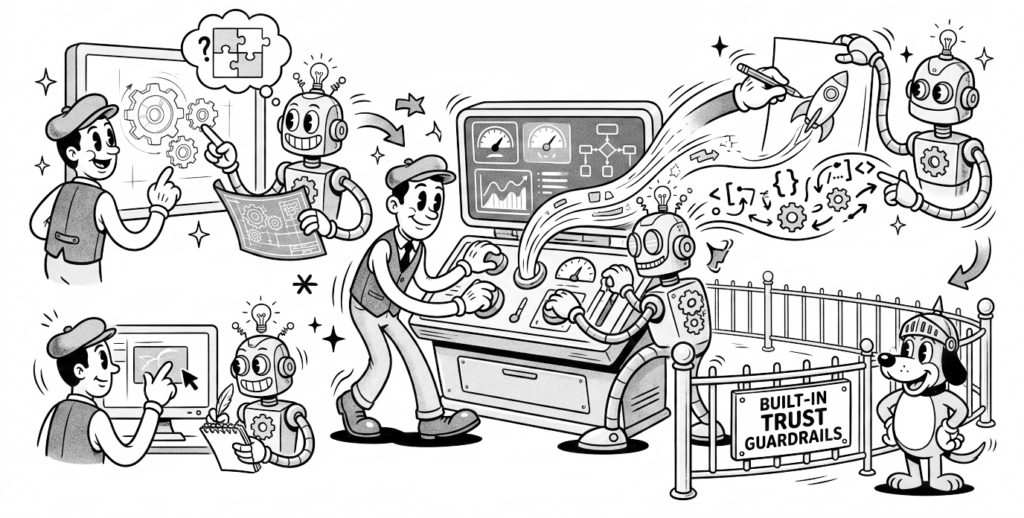
Two Key Dimensions of AI Integration
AI plays two complementary roles in this governance model.
AI for System-Supported Governance
AI enables a shift from manual, human-dependent reviews to continuous, system-supported guidance that validates designs in real time, reduces back-and-forth, and scales governance without creating bottlenecks.
AI for Intent-Aware Design Intelligence
Deeper AI integration allows the design system to understand design intent, anticipate needs, and adapt guidance over time, transforming DDS from a static rule set into an intelligent collaborator embedded in the workflow.
Measure Success
Success would be evaluated across adoption, efficiency, and trust.
Adoption and Usage
Increase in contributors actively using the unified governance plugin and AI recommendations during design creation.
Reduction in Manual Review Effort
Measurable decrease in time DDS teams spend on manual audits and review cycles.
Design System Compliance
Higher percentage of designs meeting DDS standards before review, with fewer iterations required.
Time to Standardization
Faster identification and promotion of widely used components from sandbox contributions into official DDS components.
Designer Trust Signals
High acceptance rates of AI recommendations and sustained usage over time, indicating confidence rather than forced compliance.
Risks
Introducing AI-driven governance carries meaningful trade-offs that must be actively managed.
Trust and Adoption Risk
If AI guidance feels opaque, overly prescriptive, or inaccurate, designers may ignore it or work around it, undermining governance rather than improving it.
Over-Automation Risk
Excessive auto-fixing or rigid enforcement could reduce design flexibility and discourage legitimate experimentation, especially in early exploration phases.
System Drift Risk
If learned behaviors are not carefully governed, the AI may reinforce inconsistent patterns or outdated practices instead of aligning with evolving DDS standards.
Scalability and Performance Risk
Running continuous analysis across large enterprise files must be efficient and reliable to avoid slowing design workflows.
If you want to talk through the decisions behind any of it, or what I’d do differently, I’d love that conversation.
Thank you for your time!
Other Projects

- B2B
- Systems Thinking
Modernizing Dell’s Commercial Quote Experience

- Vision
- Strategy
Shaping an AI Experience Vision Through System-Level Exploration

- Strategy
- Systems Thinking